Java Full Stack Training in BTM Layout: Skills, Roadmap & Career Guide (2026)
Last updated: August 2026 | Prepared by the training team at Ascent Software Training Institute, Bangalore
If you’re researching java full stack training in BTM Layout, Bangalore, you’ve probably already noticed the same phrase popping up in half the job listings: “Java Full Stack Developer.” It sounds impressive, maybe a little intimidating, and the job descriptions often read like a wall of acronyms — Spring Boot, REST APIs, React, Hibernate, microservices, Docker. So what does it actually mean to be one of these developers, and is it a realistic path if you’re starting from scratch?
This guide breaks it down properly — no jargon left unexplained, no vague promises. By the end, you’ll know exactly what the role involves, what you’d need to learn, roughly what it pays, and how to evaluate training options if you’re considering this path seriously.
This guide is written for: college students exploring career options, final-year engineering students, fresh graduates, non-IT professionals considering a switch, career changers from unrelated fields, and front-end developers who want to move into full stack roles.
Key Takeaways
- Java full stack developers build and connect both the front end (React/Angular) and back end (Java, Spring Boot) of an application.
- Core technologies include Java, Spring Boot, SQL, Hibernate, REST APIs, React or Angular, and Git.
- Structured beginners typically need 4–6 months to go from fundamentals to a deployable full stack project.
- Java remains one of the most consistently used enterprise languages — it’s held a top-five spot in language-usage surveys for years running.
- Bengaluru’s tech workforce has crossed one million professionals, and IT hiring in the city grew roughly 16% year-on-year through 2025–26, largely on cloud, AI, and Global Capability Centre (GCC) expansion.
- A strong portfolio needs at least one original, end-to-end project — not a tutorial clone — connecting front end, back end, and database.
What Is Java Full Stack Development?
Quick Answer: Java full stack development is the practice of building both the front end (what users see and interact with) and the back end (server logic, databases, APIs) of a web application, using Java-based technologies like Spring Boot for the server side and JavaScript frameworks like React or Angular for the client side.
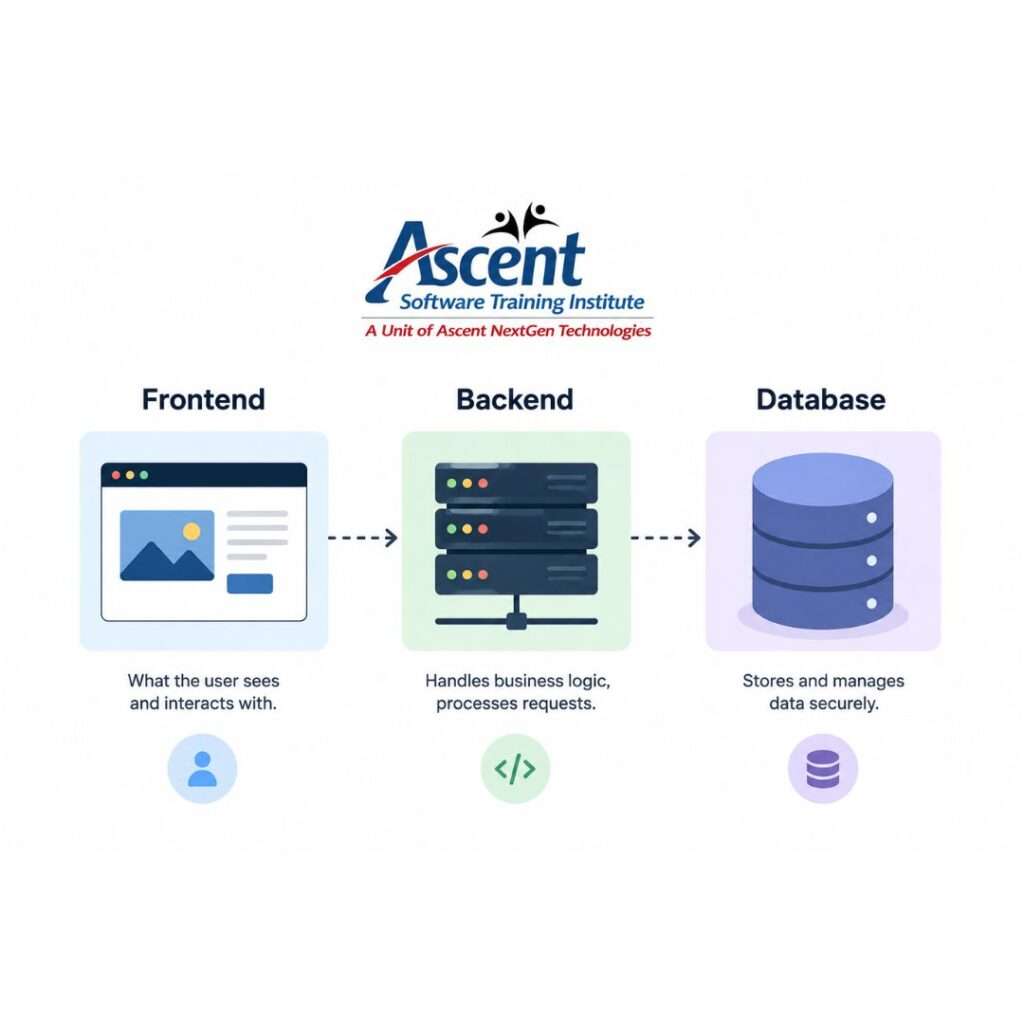
A “full stack” developer isn’t a person who knows everything about everything — that’s a myth worth killing early. It means you can work across the entire application layer: you can design a database table, write the Java logic that talks to it, expose that logic as an API, and then build the actual screen a user clicks through in their browser.
Think of a food delivery app. Someone has to build the screen where you browse restaurants (front end), someone has to write the logic that checks restaurant availability and calculates delivery time (back end/business logic), and someone has to make sure the order actually gets saved and retrieved correctly (database layer). A Java full stack developer is trained to touch all three, even if in a real job they end up specializing more in one area over time.
The “Java” part specifically refers to the back-end language and ecosystem — Java, Spring, Spring Boot, Hibernate — which remains one of the most widely used stacks in enterprise software across banking, insurance, e-commerce, and product companies.
What Technologies Make Up the Java Full Stack?
Quick Answer: A typical Java full stack combines Core Java and Spring Boot on the back end, React or Angular on the front end, MySQL or PostgreSQL for data storage, and Git plus tools like Docker and Postman for version control, containerization, and API testing.
| Layer | Common Technologies | What It Does |
|---|---|---|
| Front End | HTML, CSS, JavaScript, React or Angular | Builds the user interface — what people see and click |
| Back End | Core Java, Spring, Spring Boot, Hibernate/JPA | Handles business logic, security, and server-side processing |
| Database | MySQL, PostgreSQL, MongoDB | Stores and retrieves application data |
| APIs | REST, sometimes GraphQL | Lets the front end and back end communicate |
| Version Control | Git, GitHub/GitLab | Tracks code changes and enables team collaboration |
| DevOps Basics | Docker, Jenkins, Maven | Packages, builds, and deploys the application |
| Testing | JUnit, Postman | Verifies code and API behavior before release |
You don’t need to master every row on day one. Most training paths — and most junior job roles — expect solid command over Core Java, Spring Boot, one front-end framework (usually React), SQL, and Git. The DevOps and testing layers deepen with experience.
Which skills matter most for a beginner?
| Skill | Beginner Priority | Typical Job Importance |
|---|---|---|
| Core Java (OOP, collections) | Essential | Very High |
| Spring Boot | Essential | Very High |
| SQL | Essential | Very High |
| React or Angular | Important | High |
| Git | Essential | High |
| REST API design | Important | High |
| Docker | Basic awareness | Medium |
| Microservices concepts | Intermediate | High (grows with experience) |
Why Is Java Still Relevant for Full Stack Roles in 2026?
Quick Answer: Java remains dominant in enterprise software because of its stability, backward compatibility, and massive existing codebase in banking, insurance, telecom, and product companies. In 2026, Spring Boot’s move toward cloud-native and microservices architecture keeps Java developers in steady demand, especially in hiring hubs like Bangalore.
Newer languages get more hype, but hype doesn’t run core banking systems, insurance claim engines, or airline booking platforms — Java does, and has for two decades. Companies aren’t ripping that out. Instead, they’re modernizing it: wrapping legacy Java systems in microservices, deploying them on Kubernetes, and integrating them with modern React front ends.
The data backs this up. Java has held a place among the most widely used languages in the Stack Overflow Developer Survey for years running, alongside JavaScript, SQL, and Python — and React remains the most-used front-end framework among professional developers, which is exactly the pairing most Java full stack job postings ask for.
That’s good news for someone learning today. You’re not learning a dying skill — you’re learning the layer that connects old, stable enterprise systems to new, modern interfaces. Bengaluru’s tech workforce has crossed one million professionals, the largest concentration in the Asia-Pacific region, and India’s broader IT sector saw close to 16% year-on-year hiring growth through 2025–26, driven heavily by cloud, AI, and the expansion of Global Capability Centres (GCCs) — many of which run on Java-based enterprise systems. Areas like Electronic City, Whitefield, and the BTM Layout–Koramangala–HSR Layout belt in South Bangalore see a consistent stream of openings from product companies, service-based IT firms, and fintech startups that all rely on this stack.
What Skills Do You Actually Need to Become a Java Full Stack Developer?
Quick Answer: You need working knowledge of Core Java (OOP concepts, collections, exception handling), Spring and Spring Boot for back-end APIs, a front-end framework like React, SQL for database queries, Git for version control, and a basic understanding of how HTTP and REST APIs work end to end.
- Core Java fundamentals — variables, OOP (classes, inheritance, polymorphism), collections, exception handling. This is non-negotiable; skipping it creates gaps that show up later.
- Advanced Java + JDBC — connecting Java code to databases, understanding multithreading basics.
- Spring & Spring Boot — building REST APIs, dependency injection, Spring Security basics. (Official documentation: spring.io)
- Database & SQL — writing queries, joins, understanding normalization, and ORM tools like Hibernate.
- Front-end basics — HTML, CSS, JavaScript before jumping into React.
- React (or Angular) — components, state, hooks, connecting to back-end APIs.
- Git, Postman, deployment basics — the practical tools used daily on the job.
- A capstone project — something that ties the front end, back end, and database together, because this is what you’ll actually show in interviews.
A common beginner mistake is jumping straight to React tutorials because front-end work “looks” more exciting, while treating Core Java as something to rush through. Interviewers in Bangalore’s product and service companies still probe Core Java fundamentals hard — OOP concepts and collections questions show up in almost every technical round.
How Long Does It Take to Learn Java Full Stack Development?
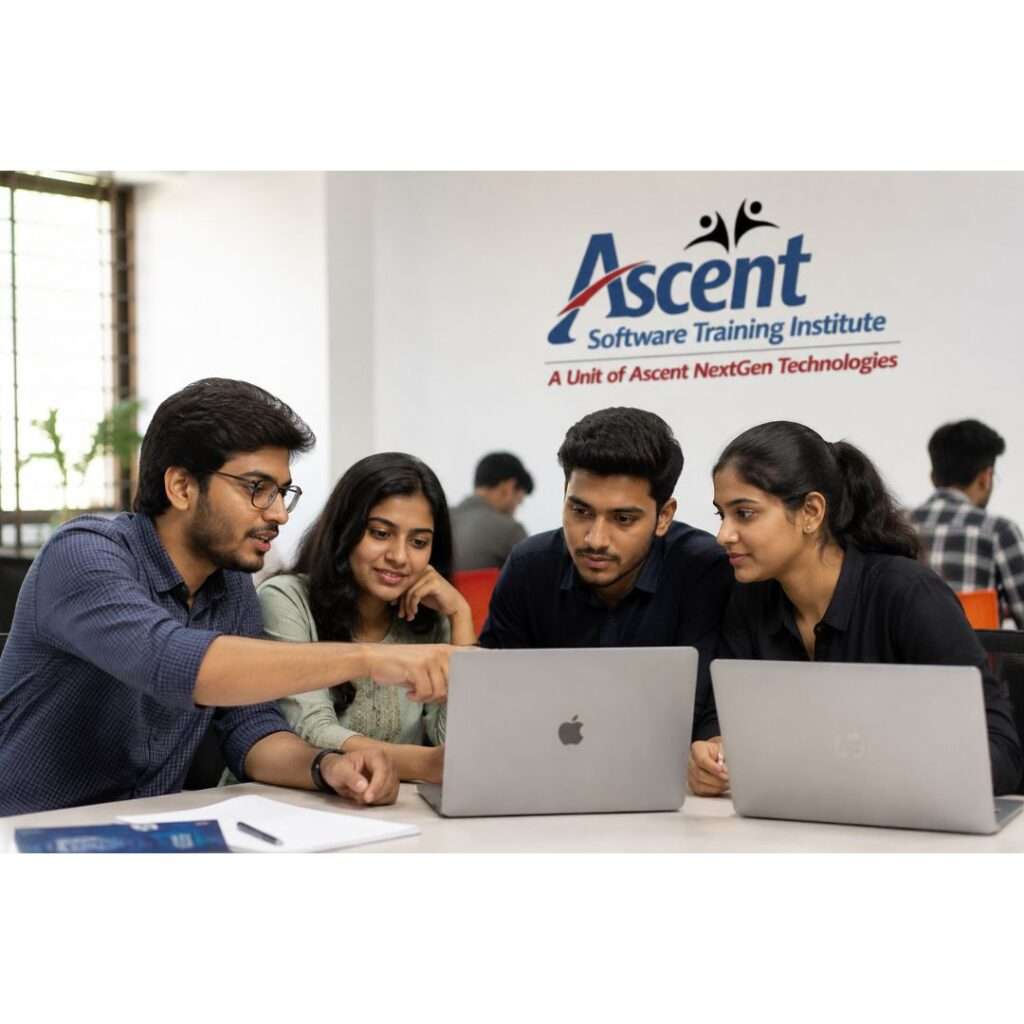
Quick Answer: Most structured training programs take 4 to 6 months for someone starting with little to no programming background, covering Java fundamentals through to a deployable full stack project. Self-paced learners often take longer — anywhere from 6 months to over a year — depending on consistency and prior exposure to programming logic.
A rough breakdown for a 5-month path:
- Month 1: Core Java + OOP
- Month 2: Advanced Java, JDBC, SQL
- Month 3: Spring & Spring Boot, REST API development
- Month 4: Front-end (HTML/CSS/JS) + React
- Month 5: Capstone project, Git workflows, interview preparation
What Does a Java Full Stack Developer Actually Do on the Job?
Quick Answer: Day to day, a Java full stack developer writes and maintains back-end APIs, builds or updates front-end components, writes SQL queries, fixes bugs across the stack, participates in code reviews, and collaborates with QA and DevOps teams — often within Agile sprint cycles.
In practice, junior developers usually start closer to one side of the stack — often back-end bug fixes or small front-end tickets — and gradually take on both as they gain trust on the team. A typical day might involve picking up a ticket from a sprint board, writing a Spring Boot endpoint, testing it with Postman, then building the React component that consumes it, and finally pushing the code through a Git pull request for review.
It’s rarely glamorous in the way bootcamp marketing makes it sound. It’s methodical, detail-heavy work — and that’s exactly why companies pay well for people who do it reliably.
Most structured programs offering java full stack training in BTM Layout sequence these eight steps in roughly this order.
What Projects Should a Beginner Build to Get Hired?
Quick Answer: The strongest beginner portfolios include at least one original, end-to-end project connecting a database, a Spring Boot back end, and a React front end — common examples are an e-commerce app, a job portal, a learning management system, or an inventory management system with authentication and a working API layer.
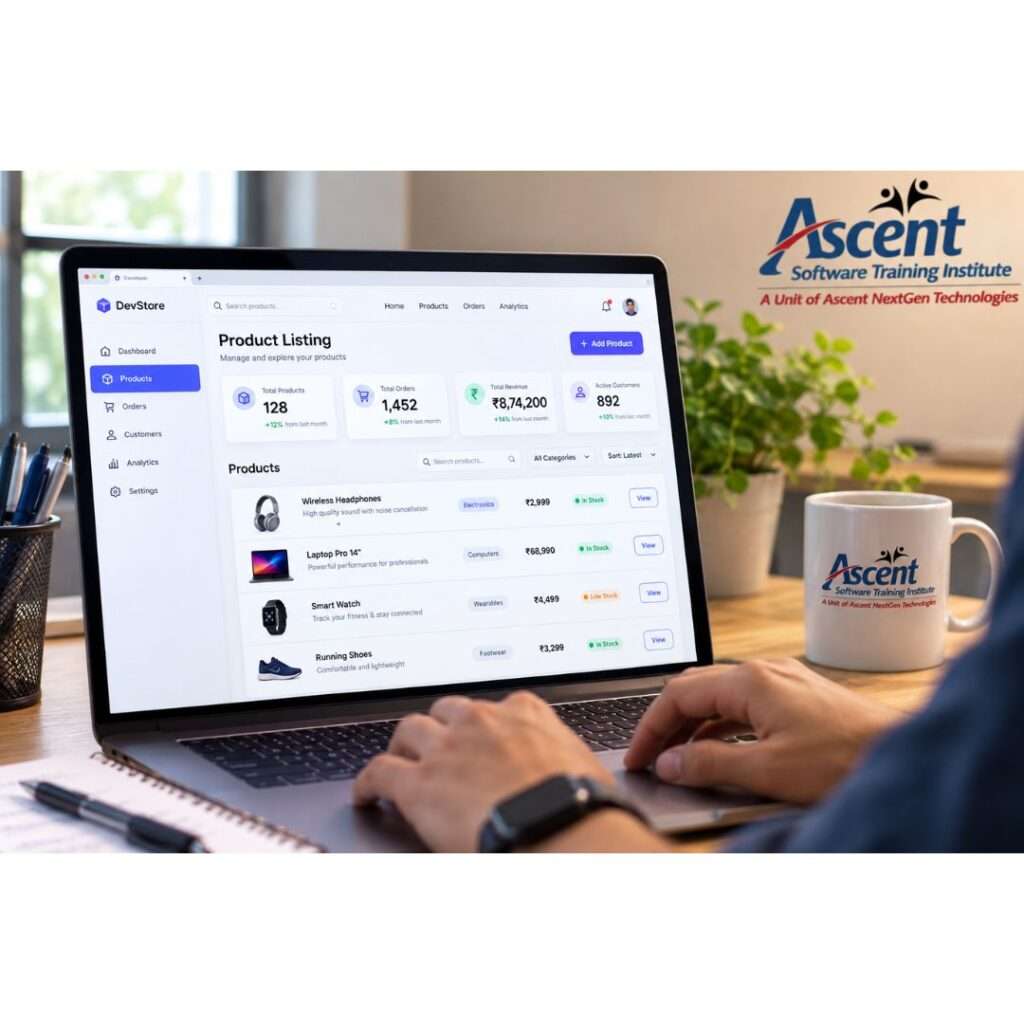
- E-Commerce Application — Front end: React product listing and cart UI. Back end: Spring Boot APIs for products, cart, and orders. Database: MySQL/PostgreSQL for product and order data. Extras: JWT-based authentication, payment-flow simulation.
- Job Portal — Front end: React forms for job posting and application. Back end: Spring Boot APIs for job listings, applications, and employer accounts. Database: relational schema linking employers, jobs, and applicants. Extras: role-based access (employer vs. applicant).
- Learning Management System (LMS) — Front end: React dashboards for courses and progress tracking. Back end: Spring Boot APIs for course content and enrollment. Database: course, student, and progress tables. Extras: file upload handling for course material.
- Inventory Management System — Front end: React tables and forms for stock updates. Back end: Spring Boot APIs for stock in/out logic. Database: relational schema with low-stock alert logic. Extras: basic reporting/dashboard views.
- Hospital Management System — Front end: React interfaces for patient records and appointment booking. Back end: Spring Boot APIs for scheduling and records. Database: relational schema linking patients, doctors, and appointments. Extras: role-based logins for staff vs. patients.
For each of these, be ready to explain the authentication approach, how the front end and back end communicate (REST endpoints), and how you’d deploy it — even a simple deployment shows you understand the full lifecycle, not just the code.
What Is the Salary Range for Java Full Stack Developers in Bangalore?
Quick Answer: Entry-level Java full stack developers in Bangalore typically start in the ₹3.5–6 LPA range depending on the company and prior projects, with 2–4 years of experience moving into the ₹7–14 LPA bracket. Product companies and fintech firms generally pay above service-based IT companies for the same experience level.
| Experience Level | Typical Range (Bangalore) | Common Employers |
|---|---|---|
| Fresher / 0–1 yr | ₹3.5–6 LPA | Service-based IT, startups |
| 1–3 yrs | ₹6–10 LPA | Mid-size product firms, IT services |
| 3–6 yrs | ₹10–18 LPA | Product companies, fintech, MNCs |
| 6+ yrs (Lead/Architect track) | ₹18 LPA+ | Enterprise & product-led companies |
These are general market ranges, not guarantees — actual offers depend on interview performance, project portfolio, and how well you can explain your own code under pressure, not just the certificate on your resume. Broader industry data shows software engineering salaries in Bangalore spanning roughly ₹7.6–23 LPA across experience levels when averaged across companies of all sizes.
Java Full Stack vs MEAN/MERN Stack — What’s the Difference?
Quick Answer: Java full stack uses Java and Spring Boot for the back end, while MEAN/MERN stack uses Node.js and Express with MongoDB — both typically paired with Angular or React on the front end. Java stacks dominate large enterprise systems requiring strict structure and scalability, while MEAN/MERN is common in startups needing faster iteration.
| Factor | Java Full Stack | MERN/MEAN Stack |
|---|---|---|
| Back-end language | Java (Spring Boot) | JavaScript (Node.js) |
| Typical use case | Enterprise, banking, insurance | Startups, MVPs, fast-moving products |
| Learning curve | Steeper initially (strict typing, OOP) | Gentler for JS-familiar learners |
| Job market (Bangalore) | Strong in IT services, product firms, BFSI | Strong in startups, product teams |
| Long-term stability | Very high — legacy + modern demand | High, but more startup-dependent |
Neither is objectively “better” — they solve overlapping problems differently. If your goal is stable, high-volume hiring in Bangalore’s service and enterprise sector, Java full stack has a wider net.
What Mistakes Do Beginners Commonly Make When Learning Java Full Stack Development?
Quick Answer: The most common mistakes are skipping Core Java fundamentals to rush into frameworks, memorizing syntax instead of understanding logic, avoiding building real projects, and ignoring SQL because it “feels less exciting” than coding.
- Framework-hopping too early. Jumping into Spring Boot before understanding plain Java leaves gaps that resurface the moment an interviewer asks “why,” not just “how.”
- No real project to show. Watching tutorials without building an original, deployable project is the single biggest reason candidates struggle in interviews.
- Underestimating SQL. Database questions catch people off guard because SQL practice gets deprioritized in favor of “cooler” front-end work.
- Ignoring Git. Not knowing how to use version control properly is an immediate red flag in any technical screening, even for freshers.
- Learning in isolation. Debugging alone for hours without a mentor or peer to unblock you slows progress far more than people expect.
Best Java Full Stack Training in BTM Layout — How Do You Choose?
Quick Answer: Look for a curriculum that goes beyond syntax into real project building, trainers with actual industry (not just teaching) experience, small batch sizes for individual doubt-clearing, and a placement process that’s transparent about outcomes rather than making blanket guarantees.
- Does the course include a real, original capstone project — not a copy-paste template?
- Are interview preparation and mock technical rounds actually part of the curriculum?
- What’s the trainer’s real industry background, not just teaching history?
- Is the batch size small enough that you’ll get individual attention when you’re stuck?
- What does “placement assistance” actually include — resume building, mock interviews, referrals — versus a vague promise?
Whether you’re comparing options in BTM Layout, Koramangala, HSR Layout, or elsewhere in South Bangalore, this same checklist works — curriculum depth, trainer expertise, batch size, and how concretely “placement support” is defined all matter more than an institute’s marketing claims.
Is Java Full Stack Development a Good Career Choice in 2026?
Quick Answer: Yes — Java full stack development remains one of the most consistently hired-for skill sets in Bangalore’s IT market because it spans both legacy enterprise systems and modern cloud-native applications. The demand is steady rather than trend-dependent, making it a reasonably safe long-term skill investment for beginners.
This is exactly why demand for java full stack training in BTM Layout has stayed steady even as the broader market gets more selective.
Looking for Java Full Stack Training in BTM Layout?
If this guide answered the “what” and “why,” the natural next step is the “how” — and that depends on where you’re starting from.
Ascent Software Training Institute, located on 100 Ft Ring Road, BTM 1st Stage (above Apollo Pharmacy), offers a placement-linked full stack program built around:
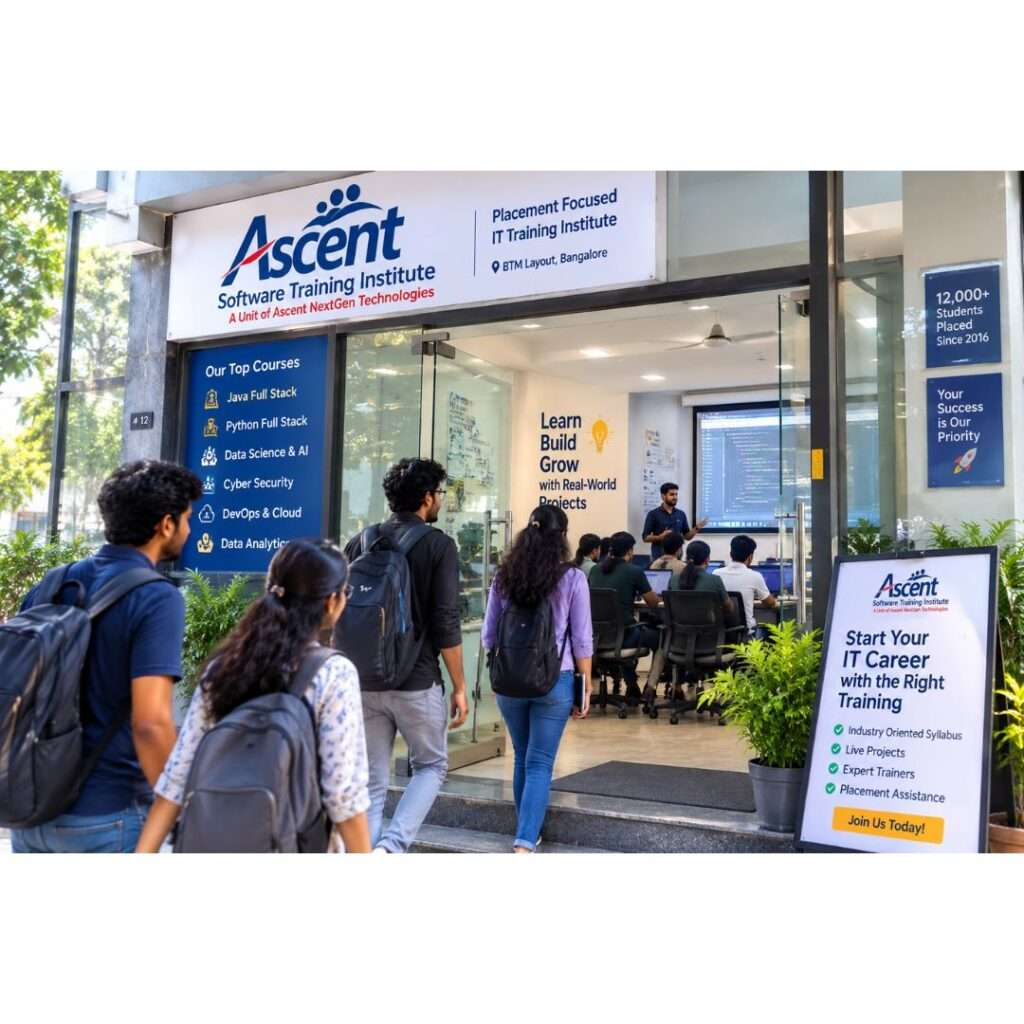
- Real, original project work (not templated clones)
- Small batch sizes for individual doubt-clearing
- Structured interview preparation and mock technical rounds
- Placement assistance including resume support and referrals
Whatever you’re evaluating — a Spring Boot and React curriculum, a Java developer training program, or a full stack course for beginners closer to South Bangalore — the checklist earlier in this guide applies here too — ask the same five questions before enrolling anywhere, including with us. This is exactly the ground covered by the best java full stack training institute in bangalore checklist above, and applies whether you’re evaluating java full stack training in bangalore with placement here or anywhere else.
Ascent Software Training Institute
100 Ft Ring Road, BTM 1st Stage (Above Apollo Pharmacy), Bangalore – 560029
Phone: 080-42191321 | Mobile: 9035037886
Email: hr@ascentcourses.com
Frequently Asked Questions
Q1. What is the difference between Java developer and Java full stack developer?
A Java developer typically focuses only on back-end logic and APIs, while a Java full stack developer works across both back-end (Java/Spring Boot) and front-end (React/Angular) layers, along with database and basic deployment tasks.
Q2. Do I need prior coding experience to learn Java full stack development?
No. Most structured training programs are designed for beginners and start with programming fundamentals before moving into Java, so prior coding experience helps but isn’t required.
Q3. Which is better for freshers in Bangalore — Java full stack or Python full stack?
Both have strong demand. Java full stack has historically had a larger footprint in enterprise, banking, and service-based IT companies in Bangalore, while Python full stack is common in data-adjacent and startup roles.
Q4. What is the average course duration for java full stack training in bangalore with placement?
Most placement-focused Java full stack programs run between 4 to 6 months, covering Core Java through to a deployable full stack project, followed by interview preparation and placement support.
Q5. Can a non-IT background student switch to Java full stack development?
Yes, career switchers regularly move into this field. It requires more discipline in the early weeks to build programming logic from scratch, but the learning path itself doesn’t require a prior CS degree.
Q6. What projects should a beginner build to get hired as a Java full stack developer?
A good starting project connects a database, a Spring Boot back end, and a React front end — examples include an inventory management system, a job portal, or a simple e-commerce application.
Q7. Is Spring Boot mandatory for Java full stack development?
Practically, yes. Spring Boot has become the standard framework for building Java back-end applications and APIs in almost every current job listing.
Q8. How is java full stack training in bangalore with placement different from a free online course?
Structured, placement-linked training typically adds guided project mentoring, mock interviews, resume support, and direct company referrals — elements that self-paced free courses generally don’t include.
Sources & Further Reading
- Stack Overflow Developer Survey 2025 — Technology
- Spring Boot official documentation
- Top IT Companies in Bangalore, Scaler (2026)
- Bangalore Hiring Trends 2026
About This Guide
Prepared by the Java Full Stack training team at Ascent Software Training Institute, Bangalore. Market and salary figures reflect general industry ranges as of August 2026.