What Does "Data Science Course With Placement" Actually Mean?
Content
Quick answer: Data science courses in Bangalore with placement typically combine Python, SQL, statistics, machine learning, visualization, and applied projects with career support — resume reviews, mock interviews, and employer connections. When comparing institutes, verify the actual curriculum, trainer background, project quality, and documented placement outcomes rather than relying on placement claims alone.
Last updated: September 2026
Bangalore’s data science hiring hasn’t slowed down — it’s just gotten more selective. Companies across the city’s IT corridor aren’t short on applicants; recruiters commonly report that they’re short on candidates who can build, deploy, and explain a model clearly in an interview. If you’re evaluating data science courses in Bangalore with placement, this guide covers what “placement-ready” means in practice, how to evaluate a course before paying for it, and what the job search actually looks like once you’re trained.
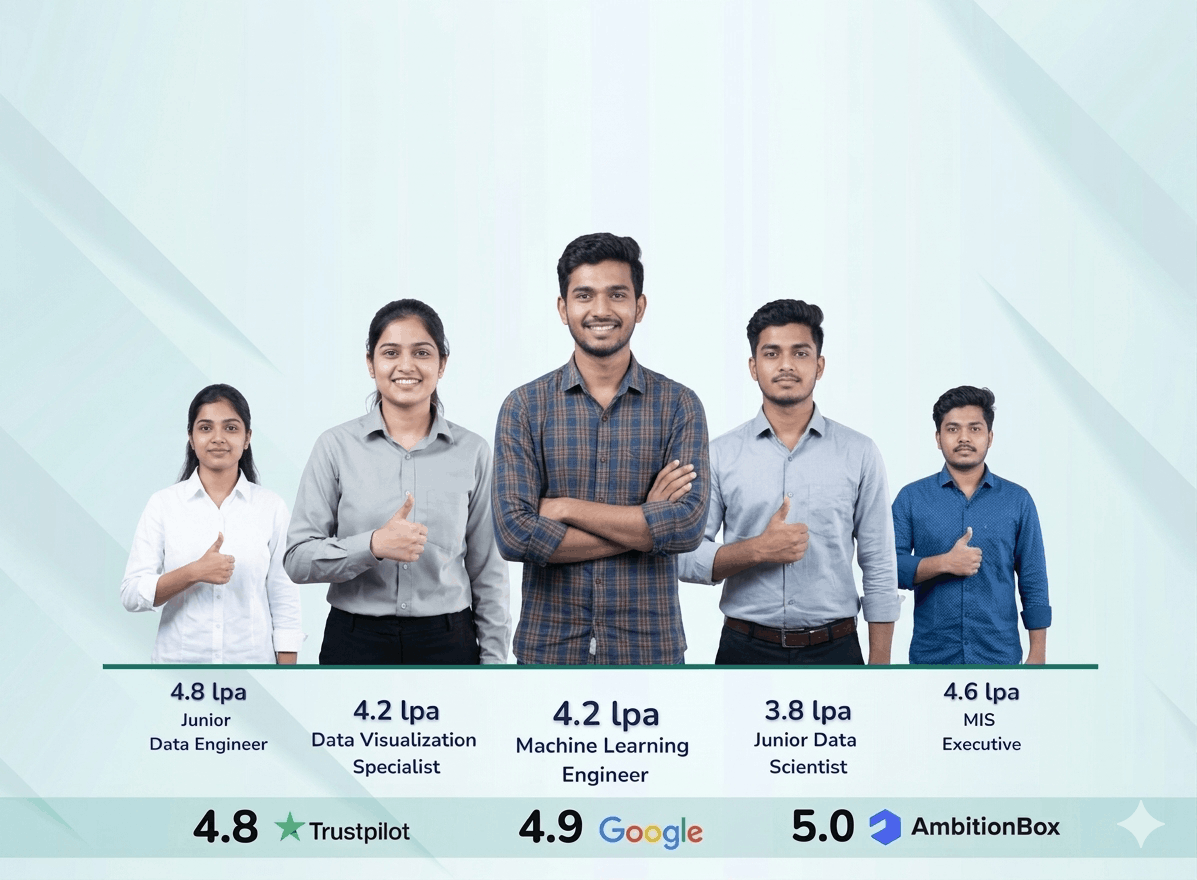
A data science course with placement is a training program that pairs technical curriculum with structured career support — resume building, mock interviews, and connections to hiring companies — aimed at getting graduates into paid roles, not just handing out a certificate. The strength of “placement support” varies significantly between institutes, so it’s worth confirming exactly what’s included before enrolling.
In practice, “placement assistance” covers a wide range. At one end, it can mean a list of job openings emailed out after the course ends, with no further involvement. At the other, it means dedicated mock interview rounds, resume reviews from people with hiring experience, and direct introductions to companies actively recruiting. Before enrolling anywhere, ask directly: how many placement drives did the last batch get access to, and can you speak with two or three recent graduates about their actual experience? An institute that’s reluctant to connect you with alumni is worth a second look.
Why Do Many Data Science Learners Choose Bangalore?
Bangalore has one of India’s largest concentrations of product companies, Global Capability Centers (GCCs), and analytics-focused startups, which commonly translates into a higher volume of entry-level data and analytics openings compared to many other Indian cities. This makes it a popular base for both training and early-career job hunting in the field.
The IT corridor running through Whitefield, Outer Ring Road, and Electronic City hosts GCCs of several global banks, retailers, and technology firms. Many of these run sizeable analytics and data teams — not just the product-company roles people usually associate with ‘data science jobs.” Add a dense startup ecosystem around Koramangala and HSR Layout. The result is a job market where a single analyst opening can draw candidates from a wide range of training backgrounds.
What Should a Good Data Science Curriculum Cover?
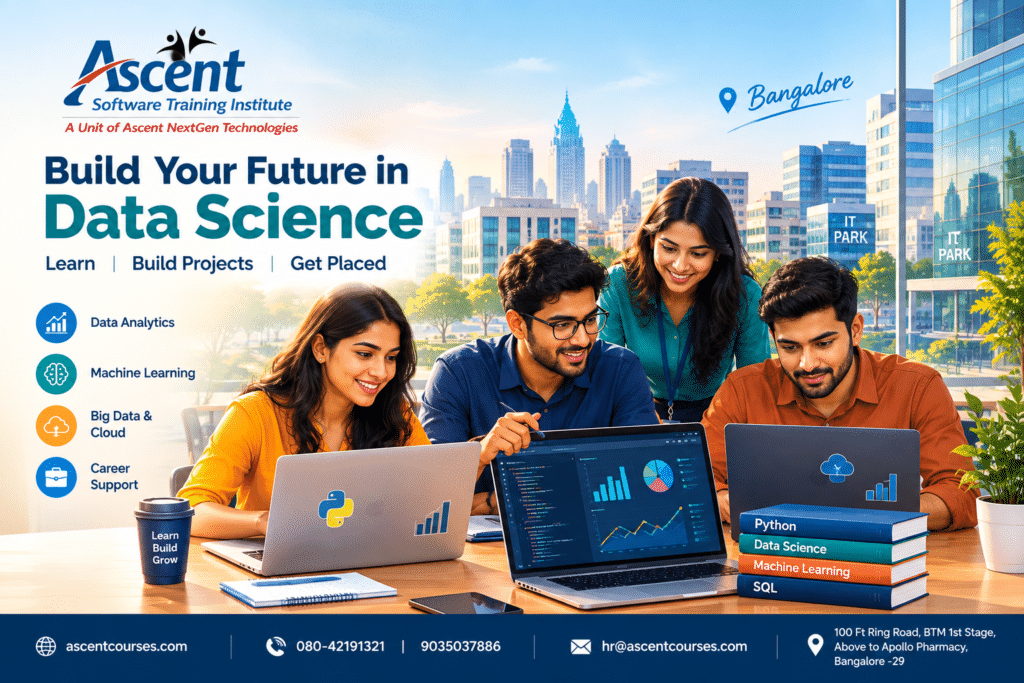
A placement-oriented data science curriculum commonly covers Python or R, SQL, statistics and probability, machine learning, data visualization, and at least a basic introduction to deployment or cloud tools — built around hands-on projects rather than slide-based theory alone. Curriculum depth and sequencing vary between institutes.
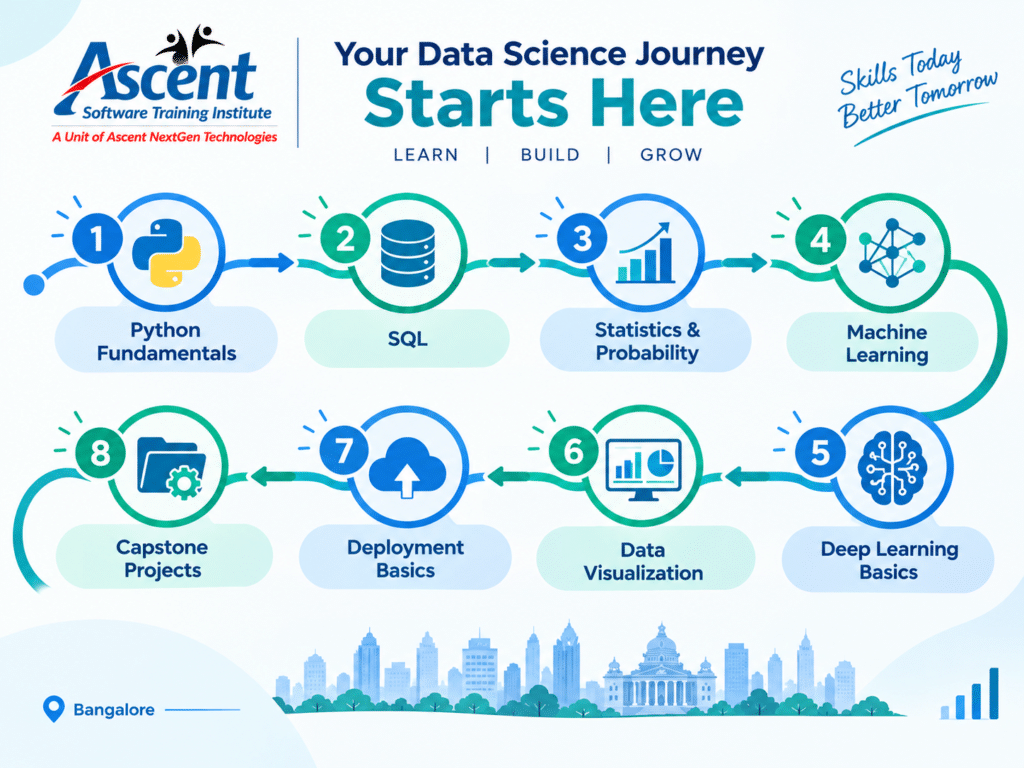
A typical sequence looks like this:
- Python fundamentals + libraries — pandas, NumPy, matplotlib/seaborn
- SQL — joins, window functions, query optimization; commonly assessed in analyst, BI, and data science interviews, though the depth expected varies by role
- Statistics and probability — hypothesis testing, distributions, A/B testing logic
- Machine learning — regression, classification, clustering, model evaluation
- Deep learning basics — neural network fundamentals, and when they’re actually the right tool
- Data visualization — Tableau/Power BI plus Python-based plotting
- Deployment basics — Flask/FastAPI, Docker fundamentals, introductory cloud (AWS/Azure/GCP)
- Capstone projects — ideally 2–3, tied to realistic business problems rather than standard textbook datasets
A common beginner mistake is skipping the less exciting middle steps — SQL and statistics — to rush toward machine learning. Interviewers tend to notice this quickly
What Job Roles Can You Get After a Data Science Course?
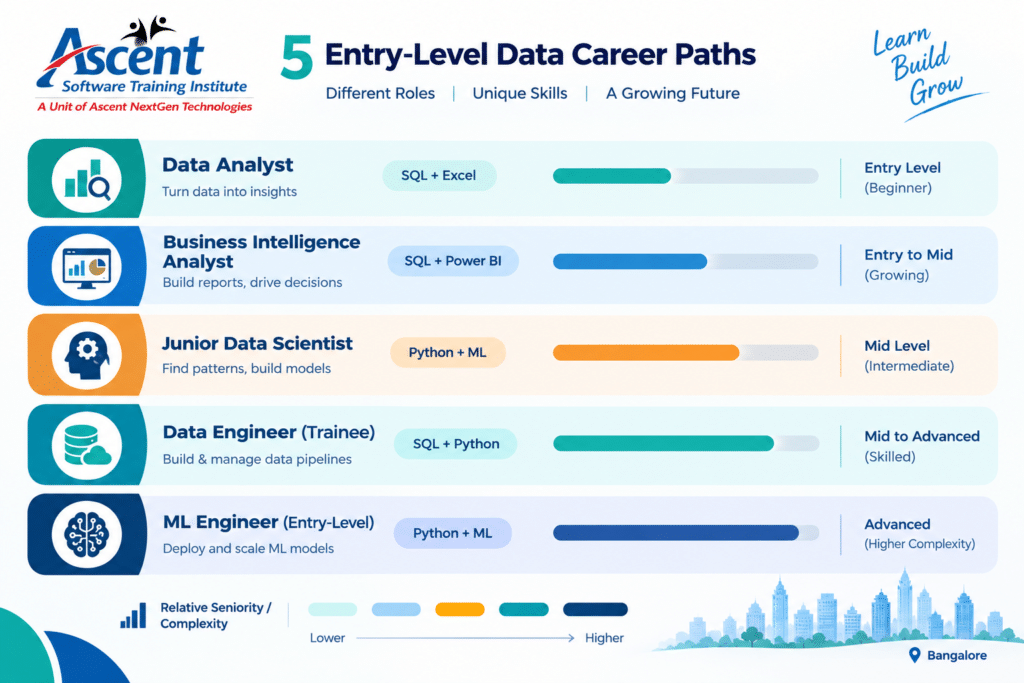
Graduates of a strong data science program typically qualify for roles such as data analyst, junior data scientist, entry-level machine learning engineer (usually alongside additional software skills), business intelligence analyst, or data engineer trainee, depending on prior background and project portfolio. Candidates from non-technical backgrounds often enter through analyst-level roles first.
What Salary Can You Expect After a Data Science Course in Bangalore?
Entry-level data and analytics salaries in Bangalore vary widely by role, employer type, and candidate background, and no single figure applies to every fresher. The ranges below are a general market snapshot, not a guarantee, and should be verified against current job-platform data before making decisions.
|
Role |
Typical Entry Requirement |
General Market Range (Freshers, Bangalore) |
|
Data Analyst |
SQL, Excel, basic Python, visualization tool |
Entry-level analyst range |
|
Junior Data Scientist |
Python, ML fundamentals, statistics, 1–2 portfolio projects |
Mid-entry range, typically above analyst roles |
|
Business Intelligence Analyst |
SQL, Power BI/Tableau, business context |
Comparable to or slightly above analyst range |
|
ML Engineer (entry-level) |
Python, ML, some software engineering/deployment exposure |
Typically the higher end of entry-level ranges |
|
Data Engineer (trainee) |
SQL, Python, basic pipeline/ETL exposure |
Comparable to junior data scientist range |
Sources & data notes: These figures should be treated as directional market patterns rather than guaranteed starting salaries. Actual compensation depends on role, experience, employer, and hiring conditions. For current, specific salary figures, cross-check a live source such as a recent job-platform salary report (e.g., Glassdoor, AmbitionBox, Naukri Insights) or a labor-market survey at the time of reading, since these numbers shift year to year.
Generally, GCCs and established product companies pay toward the higher end of these ranges compared to smaller services firms, though exceptions exist on both sides.
What Is the Eligibility for a Data Science Course in Bangalore?
Most data science courses accept candidates from any educational background — engineering, commerce, science, or arts — as long as they’re willing to build foundational programming and math skills. A bachelor’s degree is commonly expected but not always mandatory; specific eligibility criteria vary by institute.
Can a Non-IT Graduate Learn Data Science?
Yes — non-IT graduates regularly complete data science training and move into analyst or junior data scientist roles, though they typically need extra time upfront for programming and statistics fundamentals compared to candidates with a technical background. Motivation and consistent practice matter more at the beginner stage than prior degree.
Which Programming Languages Are Needed for Data Science?
Python is the most widely used language in data science roles, with SQL required for nearly all data-related positions regardless of specialization. R is used in some analytics and research-heavy roles but is less commonly required for general industry hiring than Python.
Is a Degree Required to Become a Data Scientist?
A degree is commonly preferred by employers but is not universally required, especially for analyst-level and junior roles where a strong portfolio and demonstrated skills can offset the absence of a specific degree. Requirements vary significantly by company and role seniority.
How Long Does It Take to Become Placement-Ready in Data Science?
For many beginners, 6–9 months is a practical preparation window, combining structured learning, project work, and interview preparation. The exact timeline depends heavily on prior programming and mathematics background, learning pace, and how much time is available each week.
A representative timeline:
- Months 1–2: Python, SQL, statistics fundamentals
- Months 3–4: Machine learning, first end-to-end project
- Months 5–6: Second project, visualization, deployment basics, resume building
- Months 7–9: Mock interviews, applications, a third project or independent practice, negotiation prep
Rushing this timeline is one of the more common mistakes beginners make. Institutes that promise placement within a few weeks are often optimizing for enrollment rather than employability — a gap that tends to surface quickly in a live technical interview.
How Much Does a Data Science Course Cost in Bangalore?
Data science course fees in Bangalore vary widely depending on course length, delivery mode, and depth of placement support, and no single figure represents the whole market. Rather than comparing price alone, it’s worth comparing the total value — curriculum depth, project mentoring, and placement process — against the fee before deciding.
For current, verified pricing at a specific institute, request a fee breakdown directly rather than relying on published averages, since these change over time and across formats (online, offline, hybrid).
How to Choose Data Science Courses in Bangalore with Placement
The right data science course for you depends on curriculum depth, trainer experience, project quality, and verifiable placement outcomes — not marketing claims or price alone. The most reliable approach is asking for specifics (batch size, trainer background, recent hiring partners) rather than trusting a landing page.
|
Factor |
What to Verify |
|
Curriculum |
Current modules, tools taught, and how recently updated |
|
Trainers |
Actual industry experience, not just teaching experience |
|
Projects |
Number, originality, and whether you can explain every decision made |
|
Placement process |
Mock interviews, resume review, and direct employer connections — or just a job board link |
|
Alumni proof |
Ability to speak with 2–3 recent graduates about real outcomes |
|
Mode |
Online, offline, or hybrid — and which fits your learning style |
|
Location |
Accessibility for regular in-person doubt-clearing, if that matters to you |
For learners based in South Bangalore, Ascent Software Training Institute in BTM Layout is one option worth evaluating against this checklist — its location offers reasonable access from BTM, Jayanagar, JP Nagar, and HSR Layout, which is relevant if in-person mentoring is part of how you prefer to learn.
Ascent Software Training Institute — Course Snapshot
The details below are institute-specific. Confirm current specifics directly with Ascent before enrolling, since curriculum, batch size, and offerings can change.
- Location: 100 Ft Ring Road, BTM 1st Stage, above Apollo Pharmacy, Bangalore – 29
- Course: Data Science
- Contact: 080-42191321 / 9035037886 / hr@ascentcourses.com
- Mode: Confirm current online/classroom/hybrid availability directly with the institute
- Placement support: Confirm the specific process (mock interviews, resume review, employer connections) directly, rather than assuming it matches the general industry description above
Online vs Offline Data Science Courses in Bangalore: Which Fits You Better?
Offline courses commonly offer more in-person mock interviews, direct networking, and closer trainer accountability, while online courses offer more scheduling flexibility and often lower cost. Neither format is universally better — the right choice depends on how much external structure you personally need to stay consistent.
|
Factor |
Offline (In-Person) |
Online |
|
Doubt clearing |
Immediate, face-to-face |
Often delayed, ticket-based |
|
Networking |
Direct peer + trainer network in the same city |
Limited to virtual cohort |
|
Mock interviews |
Easier to schedule in person |
Possible, but less consistent |
|
Accountability |
Higher (physical attendance) |
Depends heavily on self-discipline |
|
Cost |
Often slightly higher |
Often slightly lower |
|
Tends to suit |
Freshers, career switchers, first-time job seekers |
Working professionals with strong self-discipline |
Freshers and career switchers without an existing professional network commonly benefit more from offline or hybrid formats. In-person mock interviews and networking are simply harder to replicate remotely — though disciplined self-learners do succeed online too.
What Are the Most Common Mistakes Beginners Make in Data Science Preparation?
The most common mistakes are skipping SQL and statistics to jump straight into machine learning, building portfolio projects that copy tutorials instead of solving original problems, and underpreparing for interview communication in favor of pure technical study. Each of these can reduce placement chances even for technically capable candidates.
- Tutorial-cloning projects: Recruiters frequently see the same standard datasets reused across candidates. A project built on data you sourced or cleaned yourself tends to stand out more.
- Underweighting SQL: It’s commonly assessed across analyst, BI, and data science interviews, yet many beginners treat it as secondary to Python and ML.
- Weak “explain your project” answers: Interviewers often care more about why you made specific modeling decisions than which algorithm you used — practice explaining trade-offs out loud, not just building the model.
- No revision cadence: Concepts learned early tend to fade without periodic review; a weekly recap habit helps retention.
What Does the Data Science Hiring Process in Bangalore Typically Look Like?
The typical data science hiring process involves an initial resume or HR screen, a technical round covering SQL, statistics, and case-based problem solving, one or more rounds focused on machine learning or project discussion, and a final HR or culture-fit round. Some product companies and GCCs may include a take-home assignment or additional assessment round, depending on the specific role and hiring process.
For freshers specifically, interviewers commonly place more weight on fundamentals — SQL correctness, statistical reasoning, and clarity of thought — than on advanced deep learning knowledge, since most entry-level roles don’t require it. Being able to walk through a project end-to-end, including mistakes made and fixed along the way, tends to matter more than reciting textbook definitions.
FAQs
Q1: Are data science courses in Bangalore with placement worth the cost?
They’re generally worth it when placement support is genuine — mock interviews, resume reviews, and real employer connections — rather than just a completion certificate. Compare the fee against realistic entry-level salary ranges for your target role, and verify claims with recent alumni before enrolling.
Q2: What is the average salary after a data science course in Bangalore?
It varies by role, employer type, and candidate background — data analyst and BI roles typically start lower than junior data scientist or ML engineer roles. Check a current job-platform salary report for up-to-date figures rather than relying on a single fixed number.
Q3: Do I need a coding background to join a data science course?
No, but a willingness to build Python and SQL skills early matters. Non-technical beginners can succeed, though they should generally budget extra time — often an additional month or two — for programming fundamentals before moving into machine learning.
Q4: How is a data analyst different from a data scientist?
A data analyst primarily works with existing data — cleaning it, visualizing it, reporting insights — while a data scientist builds predictive models and works more heavily with statistics and machine learning. Many learners move from an analyst role into a data scientist role as their skills develop.
Q5: Which matters more for placement — certifications or projects?
Projects generally carry more weight. A certificate shows course completion; a well-explained project shows you can apply what you learned to solve an actual problem, which is what most technical interviews test for.
Q6: How many projects should I have before applying for data science jobs?
Two to three well-understood, original projects are generally more effective than several shallow, tutorial-based ones. Interviewers tend to weigh depth of explanation more than raw project count.
Q7: Is it better to learn data science online or at an institute in BTM Layout or nearby areas?
It depends on your learning style — online offers flexibility, while an in-person institute in areas like BTM Layout can offer more structured accountability and easier access to mock interviews and networking, which tends to help many freshers. Learners in South Bangalore often weigh both formats before choosing.
Q8: How long should I prepare before applying for data science jobs in Bangalore?
Many learners need roughly 6–9 months combining structured learning, project building, and interview practice, though this varies by background and pace. Applying before you can confidently explain your own projects often leads to avoidable rejections at the technical round.
About This Guide
Reviewed by: Imran, Manager, Ascent Software Training Institute — 15 years of experience in the field
Last updated: September 2026
Based on: General industry knowledge of data science hiring patterns, curriculum standards, and publicly observable Bangalore tech-hiring trends. Salary and market-size figures are directional and should be cross-checked against current job-platform or labor-market sources at time of publishing.
CTA
If you’re comparing data science courses in Bangalore with placement, it’s worth asking a few institutes the specific questions covered above — trainer background, batch size, project quality, and documented placement outcomes. To see how Ascent Software Training Institute’s data science program in BTM Layout holds up against that checklist, reach out at 080-42191321 / 9035037886 or hr@ascentcourses.com